
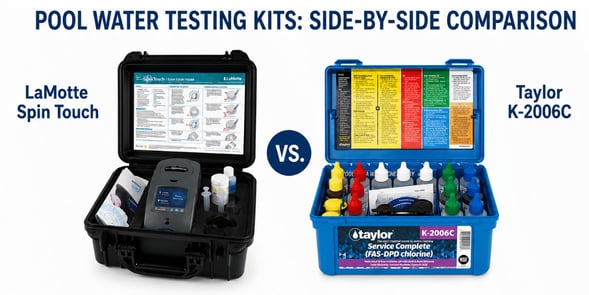
When it comes to commercial pool water testing, few debates come up more often than Taylor test kits versus the LaMotte WaterLink Spin Touch. Many operators are quick to assume that traditional drop testing is automatically more accurate, while others hesitate at the perceived cost of single-use Spin Touch disks.
We completely understand this hesitation. But accuracy is only part of the conversation. When you’re managing commercial facilities, the better question is which system delivers the most consistent results, saves staff time, and lowers total operational costs over the long term.
Quick Answer: Is the LaMotte WaterLink Spin Touch More Accurate Than a Taylor Drop Test Kit?
Yes, when properly calibrated and used with NSF/ANSI 50- certified testing methods, the LaMotte WaterLink Spin Touch delivers highly accurate, standardized water testing results that meet commercial pool requirements. While it’s a common industry assumption that traditional Taylor drop kits are inherently “more accurate,” accuracy depends less on the testing format and more on certified methodology, consistency, operator variability, and total cost of testing over time.
For many facilities, the WaterLink Spin Touch actually lowers overall costs once labor time, retesting, and reagent replacement are factored in.
Why People Still Say “Drops Are More Accurate”
This is one of the most common objections in the pool industry.
Many operators and maintenance teams have used Taylor drop kits for years, and there’s a strong sense of familiarity and trust. Taylor Technologies Complete Pool Water Tests have long been considered an industry staple for residential and commercial testing.
The assumption often sounds like this: manual = more precise. But that isn’t always true.
Commercial pool testing systems are evaluated against NSF/ANSI 50 standards, which establish performance benchmarks for equipment used in public pools and spas. When a testing system meets these standards, it has been evaluated for reliable performance and consistency in commercial environments.
That means the conversation should shift from “are drops more accurate?” to “which system produces the most consistent, repeatable, standards-aligned results in real-world use?”
The WaterLink Spin Touch is certified to NSF Level 1 accuracy (the top accuracy rating). This not only ensures you have the most accurate test results, and apply the most accurate chemical volumes, but will also become more important moving forward, as the state of Florida is transitioning to requiring all commercial and public pools to use Level 1 NSF Certified Pool Test Kits in the future.
Accuracy Is Also About Human Error
A drop kit can absolutely provide excellent readings, but it also depends heavily on the person using it.
With manual testing, results can vary based on:
- drop counting accuracy
- sample volume inconsistencies
- lighting conditions
- color interpretation
- expired reagents
- rushed testing procedures
Even small differences in technique or experience can change readings.
For example, two technicians using the same drop kit may produce slightly different chlorine or alkalinity results simply because one counted an extra drop or interpreted the color endpoint differently.
The LaMotte WaterLink Spin Touch reduces that variability, virtually eliminating the potential for human error and subjectivity. Its photometer automates the analysis process through prefilled reagent disks and digital photometric reading, producing fast, consistent results with less technician interpretation.
This is especially valuable for commercial aquatic facilities, hotels, schools and universities, municipal pools, and service companies managing multiple sites..
The Cost Pushback: “The Disks Cost Too Much”
This is usually the bigger objection we hear from managers and operators.
At $2.75 per single-use disk, some buyers immediately compare that number to the cost of liquid reagents and assume Spin Touch is more expensive.
However, that’s leaving some important factors out of your cost equation. The first critical factor is this: you actually need 3 different Taylor Test kits in order to test all the different chemical tests that are in a single series 203 Spin Touch disk.
The cost of test drops isn’t zero
Liquid reagents and replacement kits have a real cost as well. Taylor reagents must be reordered regularly, and depending on usage volume, replenishment becomes a recurring operational expense–especially when you’re replenishing 3 separate Taylor Test kits.
Here’s a look at how the costs for each Taylor Test Kit break down:
Test Kits Required & Cost Per Test (April 2026)
|
Test Kit |
Parameters Tested |
Kit Price* |
Tests per Kit |
Cost per Test |
|
Taylor K-2006C |
Free Cl, Total Cl, pH, Alkalinity, Hardness, CYA |
$150 |
~150 |
$1.00 |
|
Taylor K-1264 |
Iron & Copper |
$166 |
~100 |
$1.66 |
|
Taylor K-1106 |
Phosphate |
$50 |
~100 |
$0.50 |
*Source: Pool & Spa Test Kits – Taylor Technologies
Labor has a cost too
When you’re calculating the cost of water testing, are you also calculating your staff’s time? That time has a cost value, but it’s commonly left out of the equation.
If a manual drop test takes even 5–7 minutes for testing chlorine and pH only, and a Spin Touch test takes approximately 60 seconds to do a complete test, the labor savings alone add up quickly. Not to mention the Spin Touch test is giving you a complete water balancing picture and not just the typical chlorine and pH reading.
Let’s use a simple example:
- 4 tests per day
- 30 days per month
- 120 tests per month
At $2.75 per disk, your monthly disk cost adds up to: $330/month
Now assume manual testing takes an extra 6 minutes per test (often the case depending on who is performing the test).
That equals: 840 minutes per month = 14 labor hours.
At a conservative labor rate of $25/hour, that’s: $350/month in labor
Now compare this to the time it takes the Spin Touch to do a complete water test.
60 seconds per test x 120 tests per month = 120 minutes.
At our labor rate of $25/hour, that’s $50/month in labor!
That is a 12-hour difference and a $300/month savings on labor each month!
Then add in the cost of replacing reagents, technician inconsistency, human error, and retesting.
This shrinks the cost gap significantly, and in many cases, the LaMotte Spin Touch becomes less expensive overall.
Here’s a look at the estimated time to complete all Taylor tests.
Time to Complete All Tests
|
Test Kit |
Time to Complete |
|
Taylor K-2006C (6 parameters) |
16–26 minutes |
|
Taylor K-1264 (Iron & Copper) |
4–6 minutes |
|
Taylor K-1106 (Phosphate) |
4–5 minutes |
|
Total Time |
25–40 minutes |
The Bottom Line: Taylor Test Kits vs LaMotte WaterLink Spin Touch
When you add up the combined costs of the three Taylor Test Kits, reagent and reordering costs, and labor costs, it’s clear that this is the more expensive route.
Total Cost Summary
|
Cost per complete 9-parameter test round |
$3.16 |
|
Combined kit investment (all 3 kits) |
$366 |
|
Estimated tests before reagents expire (1 year) |
~100–150 |
Here’s the bottom line: A full 9-parameter water chemistry test costs $3.16 per round and takes roughly 25–40 minutes to complete. The K-1264 iron/copper kit at $1.66 per test is the biggest cost driver, representing over half the per-test expense.
An experienced tester can complete everything in under 30 minutes; first-timers should budget up to 45–60 minutes.
Faster Testing Means Faster Water Corrections
It’s also important to include response time in this cost discussion. Faster testing means faster chemical adjustments.
When your pool’s water chemistry drifts outside the ideal range, a delayed response can lead to water clarity issues, swimmer complaints, disease and health issues, an excessive increase in chemical use, failed audits and Health Department inspections, equipment wear and corrosion, and pool downtime and closures.
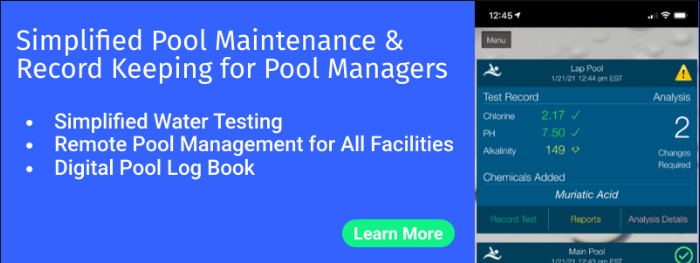
On the other hand, a one-minute digital test allows teams to make decisions faster, and that operational speed has real value. When integrated with the PoolShark H2O app, highly accurate test results are logged and recorded digitally–alerting managers any time there are issues that need attention.
If you and your staff are managing consistently high bather loads, every hour matters.
This is one reason many commercial operators move from traditional drop kits to digital systems as they scale.
Which Is Better for Commercial Pools?
For small residential pools, Taylor kits still make sense.
For commercial operations, however, your decision usually comes down to repeatability, speed, and labor efficiency.
If your team is running multiple daily tests, managing compliance logs, or servicing multiple facilities, the LaMotte WaterLink Spin Touch offers a stronger operational advantage. The upfront investment is higher, but the long-term workflow improvement is substantial.
With the WaterLink Spin Touch, each sealed SpinDisk® cartridge contains the exact amount of reagent needed to run the complete series of tests. All you or a staff member has to do is fill a reagent cartridge with less than 3mL of water, press a button, and they’ll have accurate test results for all water tests in 60 seconds.
It performs all water tests on both traditional chlorine and saltwater pools, including:
- Free Chlorine (DPD)
- Total Chlorine (DPD)
- Bromine (DPD)
- pH
- Calcium Hardness
- Total Alkalinity
- Cyanuric Acid (Pool Stabilizer)
- Copper
- Iron
- Salt
- Phosphate
Pair PoolShark H2O with the LaMotte WaterLink Spin Touch Integration
Because of its accuracy and time-saving ability, we’ve partnered with them to make adding your test results to the Pool Shark H20 app seamless.
Simply tap a button to transfer the information via Bluetooth. This logs and locks test results in your PoolShark H2O app, ensuring your logs are health department compliant. If you’re testing pool water multiple times a day–especially for multiple pools–the time savings from this alone can make a significant impact on your operations and your pool operator’s day.
When you pair the LaMotte WaterLink Spin Touch with the PoolShark H2O app, you can perform pool water tests in 60 seconds, receive instant chemical dosage recommendations to keep water in balance, and seamlessly preserve results and any related chemical adjustments digitally. Together, this frees up your pool operators and other staff members for the other important parts of their job, all while making it easy for managers to check logs and receive crucial alerts from anywhere, at any time.