
Maintaining balanced water chemistry is both critical and, at times, easier said than done. If you’ve found yourself repeatedly adjusting chemicals only to see your pool pH too high again within days—or even hours—you’re not alone. While total alkalinity is often the first place operators look, a consistently rising or too high pool pH usually points to broader system dynamics at play.
This article breaks down the most common causes of pool pH that is too high in commercial pools and what you can do to stabilize it for safer, more efficient operations.
Understanding the Relationship Between pH and Alkalinity
Before diving into root causes, it’s important to clarify a common misconception: while you should always balance alkalinity first, then pH second, balanced alkalinity does not guarantee stable pH.
Total alkalinity acts as a buffer, helping resist rapid pH changes. However, even when commercial pool alkalinity is within the recommended range (typically 80–120 ppm), other factors can continuously push pool pH too high. When that happens, operators often find themselves in a cycle of constant acid dosing—treating the symptom, not the cause.
Common Reasons Your Pool pH Is Too High
Pool water needs to be maintained in a slightly basic range, between 7.2 and 7.8. When pool pH is too high (above 7.8), it can cause skin and eye irritation while also reducing chlorine effectiveness.
Even when your total alkalinity is within range, several operational and environmental factors can continuously push pool pH higher than recommended. Understanding these underlying drivers is key to reducing constant chemical adjustments and maintaining a more stable water balance.
1. Aeration and Water Turbulence
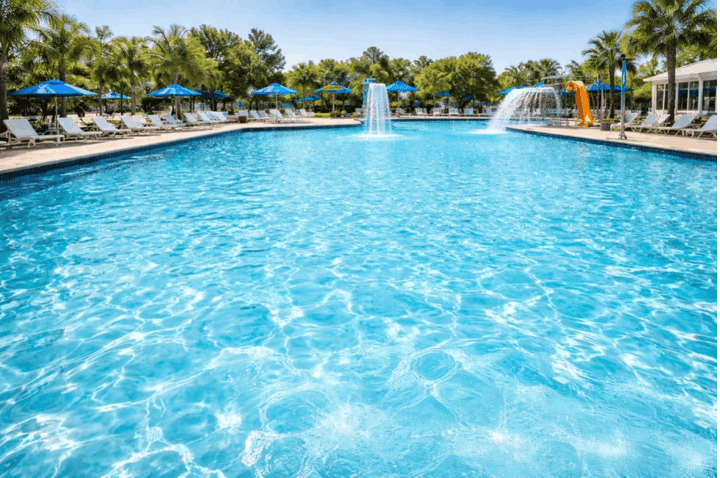
One of the most overlooked causes of pool pH being too high is turbulence (aka aeration): anything that introduces air into the water.
This includes:
- Water features like fountains and waterfalls
- Deck jets and laminar flows
- Slides and splash features
- High swimmer activity in certain zones
Aeration drives off carbon dioxide (CO₂) from the water. As CO₂ escapes, the water becomes less acidic, causing pool pH to rise too high.
What to do:
- Turn off water features during non-operating hours
- Reduce unnecessary turbulence where possible
- Monitor high-activity zones more closely
Even small adjustments like shutting down fountains overnight can significantly slow pH drift.
2. Saltwater Chlorination Systems
If your facility uses a saltwater system, this may be a primary contributor to pool pH that is too high.
Salt chlorine generators naturally cause pH to rise due to the chemical reactions and turbulence involved in producing chlorine. Specifically, they generate sodium hydroxide as a byproduct, which increases pH over time.
What to do:
- Expect a gradual upward pH trend
- Adjust your chemical dosing strategy accordingly
- Consider automation to maintain tighter control
3. High Bather Load
Heavy usage can contribute to pool pH being too high over time. Every swimmer introduces organic matter, body oils, and contaminants that impact water chemistry.
What to do:
- Increase monitoring during peak usage periods
- Ensure circulation systems are optimized
- Maintain consistent chemical dosing schedules
4. Source Water Chemistry (Hard Water)
Some fill water sources have high pH or high alkalinity right out of the tap, which can contribute to ongoing issues with pool pH staying too high.
What to do:
- Test source water regularly
- Adjust treatment protocols based on incoming chemistry
- Factor refill cycles into your balance strategy
5. Chemical Imbalances Beyond Alkalinity
Even with proper alkalinity, imbalances can still lead to pool pH that is too high.
For example::
- High carbonate levels can accelerate CO₂ off-gassing
- Improper acid dosing can create short-term fixes without stability
What to do:
- Avoid overcorrecting with large acid doses
- Use consistent, measured adjustments
- Track trends over time
6. Inconsistent Monitoring and Manual Adjustments
Manual testing and dosing can introduce variability, often leading to cycles where pool pH gets too high repeatedly:
- pH rises
- Too much acid is added
- pH drops quickly
- The system rebounds and rises again
What to do:
- Standardize testing procedures
- Ensure consistent dosing practices
- Reduce variability across staff
7. The Operational Impact of Pool pH That Is Too High
Uncontrolled pH drift can quickly become a significant operational and financial issue.
When pool pH is too high:
- Chlorine becomes less effective
- Scaling and cloudy water become more likely
- Guest experience suffers
- Compliance risks increase
Over time, this leads to higher chemical costs, increased labor, and greater wear on equipment.
How to Stabilize Pool pH When It’s Too High
Long-term control requires a shift from reactive fixes to proactive management:
- Minimize aeration when possible
- Account for system design (saltwater vs. traditional chlorine)
- Monitor trends, not just snapshots
- Implement consistent dosing strategies
- Train staff on chemistry fundamentals
A Smarter Approach to Managing Pool pH
For many operators, the challenge isn’t understanding why pool pH is too high—it’s managing it consistently.
Solutions like Pool Shark H2O are designed to:
- Continuously track pH and key parameters
- Provide real-time dosing guidance
- Reduce manual errors
- Deliver trend data for better decisions
Instead of constantly reacting to pool pH that is too high, your team can maintain stable, compliant water conditions with far less effort.
Break the Cycle of High pH
If your pool pH is too high despite balanced alkalinity, it’s a clear sign that deeper factors—like aeration, system type, and operational variability—are at play.
Addressing these root causes is the key to breaking the cycle.