

For commercial and public pool operators, maintaining proper chlorine levels is a core part of guest safety, pool reputation, and a regulatory requirement. Whether you manage a municipal facility, a hotel pool, a fitness center, or a multi-pool aquatic complex, the chemistry behind your water management program directly affects bather health, equipment lifespan, operational costs, and your facility’s business.
Ahead, we break down what “proper chlorine levels” actually mean, why consistency matters more than peak readings, and how to implement a monitoring program that works in real-world, high-use environments.
Why Chlorine Matters in Commercial Aquatics
Chlorine remains the most widely used disinfectant in the aquatics industry because it’s effective, fast-acting, and affordable. In regulated environments, your primary goal is to maintain a disinfection residual strong enough to neutralize pathogens between bathers. Common threats, including Pseudomonas, Cryptosporidium, and Legionella, spread quickly in warm, busy water.
The key is not just hitting the required parts per million (ppm); it’s maintaining a stable residual that stays effective during heavy bather load, high temperatures, and organic contamination from sunscreen, sweat, and urine.
Target Chlorine Levels for Commercial and Public Pools
If your region adopts or aligns with the Model Aquatic Health Code (MAHC), the following parameters apply (if not, these standards make a good baseline but you should always check your local, state, and county requirements):
- Free Chlorine (FC), Pools:
- Minimum 1.0 ppm
- Minimum 2.0 ppm with cyanuric acid present
- Free Chlorine (FC), Spas/Hot Tubs: Minimum 3.0 ppm
- Maximum Free Chlorine:
- 10 ppm
- 15 ppm (when cyanuric acid is present)
- Combined Chlorine (CC): Should not exceed 0.4 ppm (The MAHC identifies 0.4 ppm as the action threshold requiring remediation.)
- pH Range: 7.2–7.8 (Maintaining 7.4–7.6 improves chlorine performance and swimmer comfort.)
The MAHC emphasizes maintaining a consistent disinfectant residual, not just meeting minimums. Free chlorine is the active sanitizer responsible for inactivating pathogens, while combined chlorine indicates that contaminants are accumulating and water quality is deteriorating.
The Real Challenge: Keeping Levels Stable
Hitting 3 ppm on a morning test is easy. Keeping chlorine within range while 200 people cycle in and out of the water is the hard part.
Common causes of chlorine fluctuation in commercial pools
- Bather load spikes
Every swimmer introduces sweat, oils, sunscreen, hair products, and other organic compounds. These consume chlorine rapidly. - Sunlight (UV degradation)
Outdoor pools without stabilizer (cyanuric acid) can lose up to 90% of chlorine in two hours of direct sun. - High water temperature
Warm water accelerates chlorine consumption and pathogen growth. - Poor circulation or dead zones
Corners, ladders, steps, and zero-depth entries can suffer from low turnover. - Equipment inconsistencies
Feeders clog, automation sensors drift, and pumps lose prime, creating chlorine dips before staff notice. - High combined chlorine
Indicates stressed water and leads to chloramine odor, eye irritation, and regulatory non-compliance.
Because commercial pools are often high-demand environments, small imbalances can become major issues fast.
Chlorine Types Used in Commercial Pools
Most public facilities use one or a combination of:
- Liquid sodium hypochlorite (easy to dose, reliable, needs regular strength testing)
- Calcium hypochlorite (via automated feeders; increases calcium hardness)
- Salt chlorine generation (great for consistent levels, still requires manual testing)
- Trichlor or dichlor (usually avoided in commercial settings due to stabilizer buildup)
Each option affects pH and alkalinity differently, so your operational approach should account for the chemistry downstream of your disinfectant choice.
How Stabilizer (Cyanuric Acid) Impacts Commercial Pools
Cyanuric acid (CYA) protects chlorine from UV degradation in outdoor pools, but too much CYA significantly reduces chlorine’s germ-killing power.
Recommended maximum CYA levels for commercial pools are typically:
- 20–50 ppm (outdoor pools)
- 0 ppm (indoor pools: no sun, no need for stabilizer)
If your facility uses stabilized chlorine, such as dichlor or trichlor, CYA can climb fast. This is because CYA doesn’t degrade like chlorine, so adding the two at the same rate is a recipe for too-high CYA levels. Liquid chlorine and cal-hypo, on the other hand, contain no stabilizer, which gives you more control over stabilizer levels.
Daily, Weekly, and Monthly Testing Practices
A strong testing program prevents surprises and gives you actionable data.
Test Daily: (Multiple times depending on bather load)
- Free chlorine
- Combined chlorine
- pH
- Temperature
- ORP system check
High-use facilities should test chlorine every 2–4 hours during open times.
Test Weekly:
- Total alkalinity
- Calcium hardness
- CYA (if used)
- Filter pressure checks
- Visual inspection of feeder pumps
Test Monthly:
- Full water balance report
- ORP probe calibration
- Flow and turnover verification
- Sample sent to a commercial lab (optional but recommended)
Document everything, as Health Department inspectors and other regulators will expect it. Your test result and chemical adjustment documentation is also your only evidence in the case of an incident. Not only will it help you isolate the cause of an issue, and take steps to remediate it, it can help you in legal cases where liability is in question.
When Levels Drift Out of Range: What to Do
Even well-run pools occasionally dip or spike. Your response depends on the issue:
If chlorine levels are lower than 1 ppm, take action, as it indicates pool water is not being sanitized. You can try to:
- Increase feed or perform a manual boost
- Verify pump/feeder operation
- Check for high pH (reduces chlorine strength)
- Inspect for circulation issues
- Adding chlorine shock
High combined chlorine:
If pool water is causing itchy skin and your staff or guests smell a strong “chlorine” smell, this (along with test results to confirm) is a good indication your combined chlorine levels are too high. This is another case where chlorine can’t do its job to sanitize the pool. You can try to:
- Perform breakpoint chlorination (“superchlorination”) with a chlorine shock
- Use enzymes
- Look for any additional sources of ammonia and reduce them
- Improve air handling in indoor pools
- Reduce bather load if feasible
- Replace or clean filters if overloaded
Chlorine locked by high CYA
If CYA levels get too high, they can cause something commonly known as “chlorine lock,” where the chlorine isn’t “released” by the stabilizer and can’t sanitize pool water. When this happens, you need to:
- Partially drain and refill the pool
- Switch to a non-stabilized chlorine source
The Bottom Line: Consistency Protects Swimmers and Your Facility
As a commercial or public pool operator, you’re not only maintaining a pleasant swim experience for your guests, you’re also running a controlled, regulated environment that protects public health. Proper chlorine levels are central to that mission.
A strong, consistent chlorine management program allows you to:
- Prevent recreational water illnesses (RWIs)
- Reduce chloramine (and related odor and irritation) complaints
- Protect equipment from corrosion or scale
- Pass inspections with confidence
- Reduce chemical waste and operational downtime
With reliable testing, well-calibrated equipment, and proactive monitoring, maintaining proper chlorine levels becomes a predictable, manageable part of your daily operations.
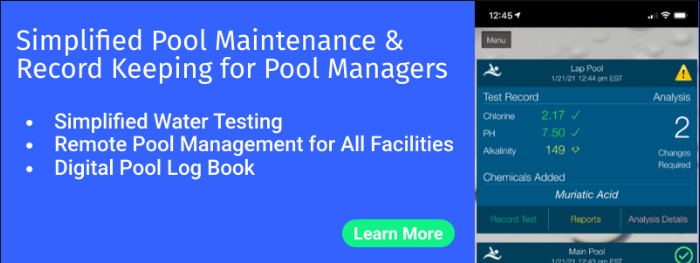
The good news is, you no longer have to rely on easily lost or damaged paper systems–you have next-generation tools and technology to help. The Pool Shark H2O app makes it quick and simple to test water and adjust chemicals with a high degree of accuracy. It automatically performs complex pool chemical math equations for you, eliminating guesswork and forgery risk.
Online access allows for auditing pool logs for safety and compliance across multiple facilities remotely. Pool managers can receive automated alerts when pools need attention or tests are missed, reducing your number of physical visits to your pools while ensuring pool water is safe, maintained, and 100% Health Department compliant.
Swimming Pool Chlorine Levels: (FAQs)
What chlorine level do health inspectors expect to see during a spot check?Many local codes require 1–3 ppm free chlorine for standard pools and 3–5 ppm for spas or warm-water environments. Inspectors also look for combined chlorine below 0.4 ppm, pH in the 7.2–7.8 range, and proper documentation. Always check your province, state, or local health authority guidelines, but these ranges can serve as a general guide.
How often should a commercial pool test chlorine levels?High-use commercial pools should test at least every 2–4 hours while open, in addition to required daily checks. Automated systems help maintain consistent feed, but manual DPD testing is still required for reporting and regulatory compliance. Indoor air quality issues, heavy bather load, or high temperatures may justify more frequent testing.
What causes chlorine levels to drop suddenly?Sudden drops are usually caused by bather spikes, equipment malfunctions, sunlight exposure, low stabilizer (CYA) in outdoor pools, or improper pH (high pH makes chlorine less effective). Check feeders, pump flow, filter pressure, and recent weather or usage patterns to determine the cause.
How do I fix high combined chlorine (chloramines)?High combined chlorine is a sign the water is stressed and disinfectant is being consumed by organic contaminants. To fix it:
- Perform breakpoint chlorination (“superchlorination”)
- Improve airflow and ventilation in indoor pools
- Clean or backwash filters
- Check for low turnover or circulation issues
Keeping combined chlorine below 0.4 ppm helps avoid odor complaints, eye irritation, and inspection problems. If chloramines remain high, your pools may benefit from UV systems to help reduce chloramines.