

Accurately calculating the volume of a pool is the foundation for every chemical decision you make as a pool operator. If you don’t know how much water is in the pool, you can’t reliably calculate chlorine, pH adjusters, stabilizer, or shock. And when dosing is off, even by a little, water quality and safety problems follow.
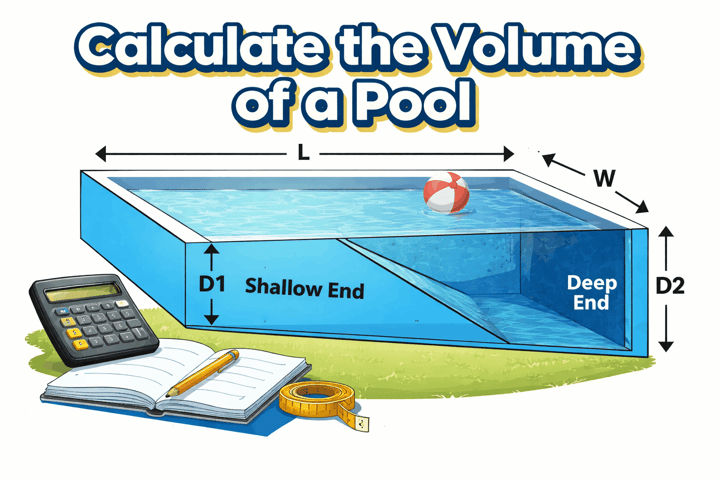
For commercial, public, and community pool operators, volume accuracy directly affects compliance, swimmer safety, chemical spend, and operational consistency. Guessing or relying on outdated build specs is one common reason otherwise well-run pools struggle with unstable water.
Why Pool Volume Accuracy Is Critical for Chemical Dosing
Chemical instructions are typically written in terms of water volume. For example, “Add X pounds per 10,000 gallons.”
If your volume estimate is wrong however:
- Chlorine may never reach effective levels
- pH adjustments overshoot or underperform
- Stabilizer slowly creeps out of range
- Shock treatments fall short or cause unnecessary closures
Over time, those errors compound and can even damage your pool equipment and materials. It’s common for operators to respond by adding more chemicals, increasing testing frequency, or chasing readings. But when the real problem is that every dose is based on a flawed assumption, this creates ongoing issues that may continue to be undetected.
Knowing the actual volume of the pool enables you to:
- Make predictable, repeatable chemical adjustments
- Maintain stable free chlorine and pH
- Reduce algae risk caused by under-dosing
- Reduce wasted chemicals from over-dosing
- Support water quality decisions during inspections
Why “Ballpark” Estimates Don’t Work in Commercial Pools
To estimate pool water volume, many facilities rely on:
- Original construction drawings
- Manufacturer specs
- A volume estimate passed down between staff
But commercial pools change over time. Renovations, depth adjustments, resurfacing, splash features, and even displacement from stairs and benches can all affect usable water volume.
Even a 10–15% error can be enough to throw chemical calculations off consistently, especially in large bodies of water.
In commercial settings like hotels, water parks, community pools, and even apartment and neighborhood pools, precision matters more than speed. Taking the time to confirm pool volume once can eliminate months (or years) of water balance issues.
How Pool Shape and Depth Affect Volume Calculations
There is no single formula for calculating pool volume because pools are not all the same shape or depth.
Common factors that must be accounted for include:
- Rectangular vs. freeform designs
- Variable depths (slopes, diving wells, zero-entry areas)
- Attached features like spas or wading pools
- Steps, benches, and ledges
Many operators underestimate how much these features change the total volume. That’s why simple “length × width × average depth” math often falls short for modern commercial pools.
Using a Pool Volume Calculator Instead of Manual Math
Manual calculations are time-consuming and easy to get wrong, especially when dealing with complex shapes or multiple depth transitions.
A pool water volume calculator simplifies the process by:
- Guiding you through measurements step-by-step
- Applying the correct formulas based on pool shape
- Accounting for depth variations
- Delivering a clear gallon estimate that can be reused
The Pool Shark H2O Pool Volume Calculator was designed specifically for operators who need a fast, reliable way to determine pool volume without guesswork. Once you know your volume, every chemical calculation becomes more accurate and easier to manage.
When your chemical calculations are more accurate, you see it in your day-to-day operations:
- Fewer chlorine dips
- More stable pH readings
- Less chemical waste
- Safer, cleaner water quality that meets regulatory requirements
- Faster response when adjustments are needed
When to Recalculate Pool Volume
Pool volume can’t be a “set it and forget it” number. If conditions or the pool change, pool volume needs to be recalculated to ensure continued accuracy.
This includes:
- A pool is renovated or resurfaced
- Depth profiles are modified
- New steps, benches, or play features are added
- Chemical performance suddenly changes without explanation
If you have ongoing balance issues that don’t respond to normal corrective action, don’t forget to reconfirm pool water volume.
Accurate Water Chemical Testing and Logs, Simplified
Once you’ve accurately calculated water volume for the pools you operate, don’t let guesswork, human error, or damaged and lost records take you off course. The PoolShark H2O app calculates complex chemical math for you, then logs and locks Health Department compliant records. Pool owners and managers are notified when tests are missed or water quality needs attention, simplifying remote management, while you gain peace of mind that your commercial water operations are safe and healthy and you have the records to prove it.
How to Calculate the Volume of a Pool FAQs:
How do I calculate the volume of a commercial pool?To calculate pool volume, you need accurate measurements of length, width, and depth, along with an understanding of the pool’s shape and depth transitions. Because commercial and public pools often have slopes, diving wells, or irregular features, using a pool volume calculator is usually more accurate than manual formulas.
Why is pool volume important for chemical dosing?Chemical dosage instructions are based on water volume. If the volume estimate is incorrect, chemicals may be under- or over-applied. That leads to unstable chlorine levels, pH swings, higher chemical costs, and increased risk of algae or water quality violations.
Can I rely on original construction plans for pool volume?Construction plans can be a helpful starting point, but they’re not always accurate years later. Renovations, resurfacing, and added features can change usable water volume. For ongoing operations, it’s best to verify volume using current measurements.
How often should pool volume be checked?Pool volume should be recalculated whenever structural changes are made or when chemical behavior no longer matches expected dosing results. Many operators also confirm volume during major seasonal start-ups or after renovations.