

Ask any traveling family: hotel pools are a serious draw–sometimes making the difference between an okay and a great stay, and a stay at your hotel versus another. Then, they’re a welcome refuge for adult travelers of all kinds, from business people seeking a quiet workout to couples looking for fun and relaxation.
Hotel pools are also a significant operational responsibility. And as you’re well familiar, safety is not just about preventing accidents. It’s about protecting guests, reducing liability, meeting regulatory standards, and preserving your property’s reputation.
Whether you manage a boutique property or a large resort, a proactive hotel pool safety program should combine water quality control, physical safeguards, trained staff, documentation, and clear communication.
This blog will walk you through some of the key components of a hotel pool safety program.
1. Maintain Proper Water Chemistry and Sanitation
Safe water is the foundation of hotel pool safety. Improper chemical balance can lead to:
- Recreational water illnesses (RWIs) & lawsuits
- Eye and skin irritation
- Corrosion or surface damage
- Failed inspections
- Guest complaints
- Bad reviews, reputational damage, and loss of business
When a potential guest reads several reviews about the state of your pool, it also makes them second-guess the cleanliness and standards of the rest of your hotel–from rooms to food service–and look elsewhere.
Core Water Chemistry Standards
Always check your local state and municipal regulations as they do vary. That said, the CDC’s Model Aquatic Health Code (MAHC) is a great guide, and many jurisdictions align with it already.
Based on this, it’s typical to expect to maintain:
- Free chlorine: 1–3 ppm (pools) and 3–5 ppm (spas)
- pH: 7.2–7.8
- Total alkalinity: 80–120 ppm
- Cyanuric acid: As regulated locally, at or below 40 ppm
Daily testing - often multiple times per day during high occupancy—is essential. Automated chemical controllers can help maintain consistent levels, but manual verification and logged documentation still remain critical and are often required by law.
Strong documentation protects your facility during inspections and in the event of an incident.
2. Prevent Drowning and Entrapment Hazards
Drowning remains the most serious risk in commercial pools. While lifeguards are not always required at hotel pools, operators are still responsible for minimizing risk.
Key protective elements include:
- Clearly posted “No Lifeguard on Duty” signage (if applicable)
- Life ring and shepherd’s hook accessible and visible
- Compliant anti-entrapment (VGB) drain covers meeting federal requirements
- Clearly marked depth indicators on deck and pool walls
- Slip-resistant decking
Ensure that drain covers are compliant with the Virginia Graeme Baker Pool & Spa Safety Act of 2007 and replaced per manufacturer lifespan recommendations. Missing, expired or damaged covers are a major liability exposure.
3. Control Access and Supervision
Unrestricted access increases risk, especially after hours.
Access Control Best Practices
- Keycard-controlled pool gates
- Self-closing, self-latching gates
- Posted hours of operation
- Security camera monitoring
- After-hours alarms where required
Hotels should also clearly state that children must be supervised by an adult. While signage alone does not eliminate risk or liability, it supports risk mitigation efforts.
For indoor pools, pay special attention to humidity control and ventilation to prevent air quality issues and surface slip hazards.
4. Train Staff in Emergency Response
Even if your hotel pool doesn’t require dedicated lifeguards, you need to ensure the following safety items are kept by the pool at all times:
- First aid kit with band-aids, gauze, tape, eyewash, anti-bacterial ointment, etc.
- CPR Mask
- Disposable latex gloves
- Bloodborne pathogen control kit
- Backboard with head immobilizer
- 10-foot pole
- Rescue tubes
- A working telephone
You need to have at least one CPR and First Aid-certified staff member on duty at all times, and your team must be prepared to respond quickly and appropriately to emergencies.
Front desk, maintenance, and management staff should be trained in:
- CPR and AED (automated external defibrillator) use
- Emergency communication protocols
- Incident reporting procedures
- Basic pool equipment shutdown procedures
An accessible AED near the pool area can significantly improve survival outcomes during cardiac emergencies; many jurisdictions require this, but even if yours doesn’t, your pool should have one.
Develop a written Emergency Action Plan (EAP) that outlines:
- Who responds
- Who calls emergency services
- Who manages bystanders
- How documentation is completed
Conduct periodic drills to ensure staff readiness.
5. Prevent Slip-and-Fall Accidents
Slip-and-fall incidents are among the most common hotel pool liability claims.
To reduce risk:
- Use slip-resistant deck materials
- Maintain proper drainage away from walkways
- Immediately address algae growth
- Install adequate lighting for evening use
- Place caution signage during cleaning
Regular inspections should include decking, ladders, handrails, slides (if present), and steps.
6. Maintain Accurate Documentation and Inspection Logs
Documentation is not optional in commercial pool management.
Maintain logs for:
- Daily water chemistry testing
- Chemical adjustments
- Filter backwashing
- Equipment maintenance
- Incident reports
- Health department inspections
Digital pool log systems can improve consistency and audit readiness. In the event of a claim, detailed logs demonstrate operational diligence.
7. Comply with ADA Requirements
Public and commercial pools must meet accessibility standards under federal law.
Accessible entry options may include:
- Fixed pool lifts
- Sloped entries (ramps)
- Transfer walls or systems
Ensure lifts are functional, charged (if battery-operated), and not obstructed. Staff should know how to operate them safely.
8. Prepare for Seasonal and High-Occupancy Risks
Peak travel seasons increase swimmer load, which affects chlorine demand, filtration performance, surface wear, and incident likelihood.
During high-occupancy periods:
- Increase water chemical testing frequency
- Enforce bather load limits
- Remind guests of hygiene practices (including pre-swim showers)
Clear water is not always safe water. Chemical balance and filtration performance matter more than appearance alone.
Prevent, Detect, Train, and Maintain
Hotel pool safety is not a single checklist; it’s an ongoing operational discipline. From water chemistry management to ADA compliance and emergency preparedness, every component contributes to guest safety and legal protection.
For commercial pool operators and property managers, the most effective strategy combines prevention, documentation, training, and proactive maintenance. A well-managed pool protects your guests, your brand, and your bottom line.
From pool chemical safety issues to controlling contaminants and disease, safe and clean water is also complex. Your pool logs will be checked by your health department inspector, and in the case of injury or illness, they’re your only evidence to confirm you were doing everything correctly to keep the pool water safe.
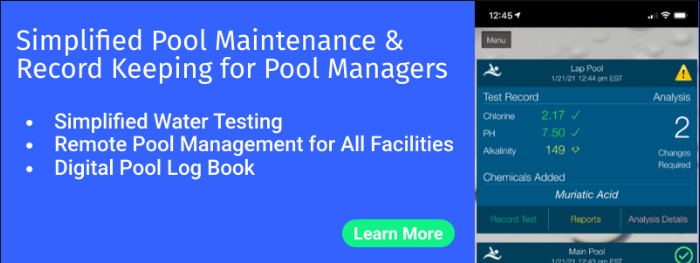
It’s why we created the Pool Shark H2O app: paper pool logs get wet, damaged, or lost, and they’re easy to forge. With our app, you can automatically log, save, and lock pool water test results within minutes–seconds if you pair it with the LaMotte Spin and Touch automated pool tester.
It also automatically calculates chemical corrections for you–saving you money on pool chemicals, and ensuring your pool water is top quality and safe at all times.
Hotel Pool Safety FAQs
What are the most important safety requirements for hotel pools?
The most critical requirements include proper water chemistry maintenance, compliant drain covers, required safety signage, accessible rescue equipment, ADA-compliant entry, and documented inspection logs. Local health department regulations determine specific operational standards.
Are lifeguards required at hotel pools?
In most U.S. jurisdictions, lifeguards are not required at standard hotel pools. However, signage stating “No Lifeguard on Duty” is typically mandatory. Even without lifeguards, operators remain responsible for maintaining a safe environment. This includes having a CPR and First Aid certified staff member on duty at all times.
How often should hotel pool water be tested?
Commercial pools, including hotel pools, are generally tested at least two to three times per day, and more frequently during peak occupancy. Automated chemical controllers help maintain balance, but manual testing and documented logs are still required in most jurisdictions.
What increases liability risk at hotel pools?
Common risk factors include improper chemical levels, missing drain covers, inadequate signage, poor lighting, slippery decking, lack of documentation, non-functional ADA lifts, and insufficient emergency response training.
