
Saltwater pools are often misunderstood as “low maintenance,” but commercial and public facilities know better. While salt chlorine generators (SCGs) produce a steady chlorine residual, which can improve chlorine consistency, they do not eliminate the need for shocking. In high-bather, regulated environments, shock treatment remains a critical operational tool for restoring water quality, controlling combined chlorine, and maintaining compliance.
Ahead, we’ll explain the when, why, and how to shock a saltwater pool in commercial and community settings—without damaging equipment or disrupting operations.
Why Saltwater Pools Still Need to Be Shocked
A saltwater pool is still a chlorine pool. The only difference is how chlorine is generated. Instead of adding chlorine manually, saltwater systems use a generator that produces free chlorine from dissolved salt through electrolysis.
In commercial and public pools, heavy use introduces large amounts of organic contaminants—sweat, sunscreen, body oils, and more—that quickly overwhelm the sanitizer residual. When chlorine combines with these contaminants, it forms combined chlorine (chloramines), which reduce disinfection effectiveness and cause odor and irritation.
Shocking breaks down these chloramines and restores chlorine’s sanitizing power.
When to Shock a Commercial Saltwater Pool
Commercial saltwater pools should be shocked when any of the following conditions occur:
- Combined chlorine exceeds 0.4 ppm
- A strong “chlorine smell” is present
- Water appears cloudy or dull
- After heavy bather load or special events, such as parties, swim meets, or busy holidays
- Following a fecal, vomit, or blood contamination incident
- After storms or anytime there’s visible, significant debris
- When chlorine demand remains high despite normal generator output
Routine shocking is not typically required, but reactive and preventative shocking are essential tools in high-use environments.
What Type of Shock Should You Use?
For commercial and public saltwater pools, non-stabilized chlorine shock is recommended. Your best options are:
- Calcium hypochlorite (cal-hypo): Cal-hypo is fast-acting, does not add cyarunic acid (CYA) which helps reduce build-up and ‘chlorine lock’, and is commonly approved for commercial facilities. One note about this: you may want to avoid it as it can release calcium that leaves behind an unsightly build-up. It’s more likely to happen in saltwater pools because the water already has a high mineral concentration.
- Liquid sodium hypochlorite: Liquid sodium hypochlorite is both effective for breakpoint chlorination and easier to dose precisely in large pools.
And while there are other types of shock, it’s best to avoid the following types when shocking a saltwater pool:
- Dichlor or trichlor shock: These add stabilizer (CYA), which can reduce chlorine effectiveness if levels climb too high. It’s easier to control the amount of CYA in your pool when you use a chlorine type without it already added in (unstabilized chlorine).
- Your saltwater generator’s superchlorination mode: while this mode can be effective in smaller pools with low bather loads, it’s not recommended for complex pool environments. You will more quickly and more effectively be able to superchlorinate (shock) your pool when you use a traditional shock treatment.
Step-by-Step: How to Shock a Saltwater Pool
1. Test and document current water chemistryTesting water parameters is not only required, but it also helps ensure you’ll catch elevated chloramine levels in a timely manner and have a benchmark before your shock treatment. Before you shock your saltwater pool, test and record:
- Free chlorine (FC)
- Combined chlorine (CC)
- pH
- Water temperature
If CC is above 0.4 ppm, breakpoint chlorination is required.
2 - Lower pH to 7.2–7.8Chlorine is significantly more effective when water pH is between 7.2 and 7.8. Adjust pH using either a pH increaser or reducer before shocking to improve efficiency and reduce chemical waste.
3 - Disable or override the salt chlorine generatorTurn off or reduce the salt chlorine generator during shocking. High chlorine levels can trigger system alarms or cause premature cell wear.
4 - Calculate the proper shock doseFor breakpoint chlorination, raise free chlorine to 10 times the combined chlorine level. You can use a pool shock calculator to help, or the PoolShark H2O app will calculate for you.
Example:
- Combined chlorine = 0.5 ppm
- Target Free chlorine = 5 ppm above current level
Always follow manufacturer dosing instructions and local health codes.
5 - Add shock evenly with circulation running- Apply the shock treatment slowly to the water around the pool perimeter or via approved feed systems
- Ensure pumps and filters are operating continuously
- Avoid dumping shock directly into skimmers or near salt cells
Continue circulation and retest every 2–4 hours. Combined chlorine should drop below 0.4 ppm.
7 - Return pool to normal operationOnce Free Chlorine returns to code-compliant levels (below 10ppm in most areas):
- Reactivate the salt chlorine generator
- Adjust output to maintain residual
- Document all readings and actions taken
Operational Best Practices for Saltwater Pool Shocking
Shocking should be viewed as corrective maintenance, not a failure of the system. Here are a few additional tips and best practices:
- Shock after hours whenever possible to avoid closures
- Maintain slightly higher operational chlorine targets to prevent dips
- Clean salt cells regularly to ensure proper chlorine production
- Monitor CYA closely in outdoor saltwater pools
- Document all shock treatments for inspections
PoolShark H2O Makes Testing, Shocking, and Documenting Easier and Faster
While shocking your pool, whether it’s saltwater or traditional chlorine, is an expected necessity from time to time, properly testing, adjusting, and recording results ensures you do so in a timely manner–before water becomes unsafe and risks either a health incident or a Health Department violation (or both).
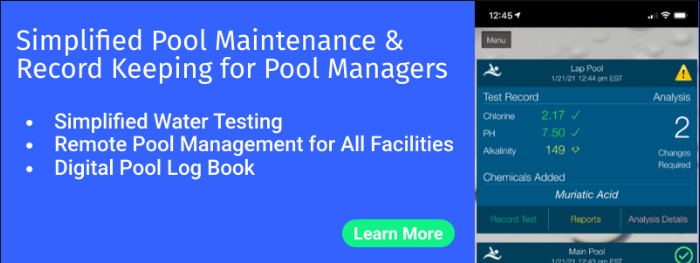
PoolShark H2O makes it easy, fast, and 100% Health Department compliant. The app performs complex water quality equations automatically, with a high degree of accuracy, then logs, locks, and digitally archives test results and adjustments. No more lost or forged pool test records, and facility or pool managers can receive alerts remotely when pools need attention.
As a result, you see reduced risk, more accurate records, and faster, simpler pool maintenance that can even reduce your chemical use and costs.
How to Shock a Saltwater Pool FAQs
Can you shock a saltwater pool without turning off the salt system?No. In commercial pools, the salt chlorine generator should be turned off or overridden during shock treatment to prevent equipment damage, inaccurate readings, and over-chlorination.
How often should a commercial saltwater pool be shocked?There is no fixed schedule for shock treatments. Commercial saltwater pools should be shocked as needed, typically when combined chlorine exceeds 0.4 ppm, after heavy bather load, or following contamination events.
What chlorine level should you shock a saltwater pool to?For breakpoint chlorination, raise free chlorine to 10 times the combined chlorine level. For example, 0.5 ppm combined chlorine requires raising free chlorine by 5 ppm.
What happens if you don’t shock a saltwater pool?Without shocking, chloramines build up, leading to odor, eye irritation, reduced disinfection, cloudy water, and potential health code violations.